

What happened? Dubai Metro turned 17 on September 9, 2026, marking 17 years since the Red Line officially opened in 2009.
Who is affected? The network is used by residents, commuters, tourists and workers across Dubai, with ridership continuing to grow.
Why does it matter? The Metro has become a major part of daily life in Dubai, carrying nearly 2.8 billion passengers since launch. Its next phase will include the Blue Line in 2029 and the Gold Line in 2032.
- Location: Dubai, UAE
- Organisation: Dubai’s Roads and Transport Authority (RTA)
- Status: Dubai Metro turns 17 on September 9, 2026
- Who is affected: Residents, commuters, tourists and daily public transport users
- Business impact: Better connectivity between residential, commercial and business districts
- What’s next: Blue Line in 2029, followed by the Gold Line in 2032
Dubai Metro turns 17 on September 9, 2026, marking 17 years since the Red Line first began operations. What started with just 10 stations has grown into one of the most important parts of Dubai’s public transport system.
According to the Roads and Transport Authority (RTA), Dubai Metro carried 294.7 million passengers in 2025, up 7 per cent from the previous year. Since its launch, the network has carried nearly 2.8 billion passengers, showing just how deeply the Metro has become part of everyday life in the emirate.
But the anniversary is not only about looking back. With the Blue Line under construction and the AED 34 billion Gold Line approved, Dubai’s Metro network is entering another major phase of expansion.
How did Dubai Metro begin?
Dubai Metro officially opened on September 9, 2009, in a launch that became one of the city’s defining infrastructure moments.
The Red Line initially operated with 10 stations, connecting key parts of Dubai. These included Rashidiya, Terminal 3, City Centre, Al Rigga, Union, Khalid Bin Al Waleed, Al Jafiliya, Financial Centre, Mall of the Emirates and Nakheel Harbour & Tower.
The Green Line followed two years later, opening on September 9, 2011.
The network has since expanded alongside Dubai itself. New communities, business districts, shopping destinations and major attractions have all benefited from easier access to public transport.
One of the biggest additions was Route 2020, which extended the Red Line towards Expo City Dubai and helped connect the Metro with the Expo 2020 site.
Dubai Metro at 17: 17 years of milestones
Dubai Metro’s journey can be traced through a series of major milestones that transformed it from a new transport project into a key part of everyday life in the emirate.
- 2009 — Dubai Metro opens: The Red Line officially opened on September 9, 2009, with the launch taking place at 9:09 pm. Only 10 stations were operating when the Metro began serving passengers.
- 2010 — Network expansion begins: The Red Line continued expanding its reach, adding more stations and giving commuters access to a larger stretch of Dubai.
- 2011 — Green Line joins the network: Two years after the Red Line opened, the Green Line launched on September 9, 2011. It strengthened connections across older and more densely populated parts of Dubai.
- 2012–2013 — Ridership grows: As more residents began using the Metro for daily commutes, the network became an increasingly important part of Dubai’s public transport system.
- 2014 — Metro becomes a daily essential: With the network connecting major residential, commercial and leisure areas, Metro travel became a regular choice for thousands of commuters and visitors.
- 2015 — Dubai’s transport network becomes more connected: Metro use increasingly worked alongside buses, taxis and other RTA services, making it easier for passengers to combine different modes of transport.
- 2016 — Dubai Metro reaches a new milestone: Passenger numbers continued climbing as Dubai’s population, tourism sector and business activity expanded.
- 2017 — Eight years on: By this stage, the Metro was no longer viewed simply as a new infrastructure project. It had become part of Dubai’s everyday city experience.
- 2018 — More than transport: The Metro increasingly became part of Dubai’s visitor experience, giving tourists an affordable way to reach major shopping, business and entertainment destinations.
- 2019 — Dubai Metro turns 10: The network marked its first decade. Sheikh Mohammed bin Rashid Al Maktoum recalled how the Metro had once been a childhood dream inspired by a visit to London in 1959.
- 2020 — Metro supports a changing city: Despite an unprecedented period for global travel and public transport, the Metro remained an important part of Dubai’s mobility infrastructure.
- 2021 — Route 2020 changes the network: The extension towards Expo 2020 Dubai expanded the Metro’s reach and connected the exhibition site to the wider public transport system.
- 2022 — Green Line expansion strengthens connectivity: With the network now serving more parts of Dubai, Metro travel became increasingly integrated into daily journeys across the emirate.
- 2023 — Ridership rebounds: Passenger numbers continued recovering as tourism, business travel and everyday activity returned strongly across Dubai.
- 2024 — Metro usage keeps climbing: Growing passenger numbers reflected Dubai’s expanding population and continued demand for public transport.
- 2025 — A record year: Dubai Metro carried 294.7 million passengers, according to RTA, marking a 7 per cent increase compared with 2024. Since its launch, the Metro had carried nearly 2.8 billion passengers by the end of the year.
- 2026 — The next chapter begins: Dubai Metro turns 17 with major expansion plans already underway. The Blue Line is scheduled to open on September 9, 2029, while Dubai has also approved the AED 34 billion Gold Line, scheduled for completion on September 9, 2032.
How many people use Dubai Metro today?
Passenger numbers show how quickly Dubai Metro has become part of the city’s daily routine.
RTA recorded 294.7 million Metro passengers in 2025, representing a 7 per cent increase compared with 2024. In the first half of 2026 alone, the Metro carried 136.5 million passengers.
RTA also reported that Dubai’s public transport, shared mobility and taxi network handled 348.1 million riders during the first six months of 2026. The Metro accounted for the largest share, at 39.2 per cent.
Busy interchange stations such as BurJuman and Union continue to play an important role because they connect different parts of the network and allow passengers to switch between Metro lines.
For tourists, the system also provides direct access to several of Dubai’s best-known areas and attractions, including Downtown Dubai, Dubai Mall, the Museum of the Future and Dubai Marina.
What is happening with the Dubai Metro Blue Line?
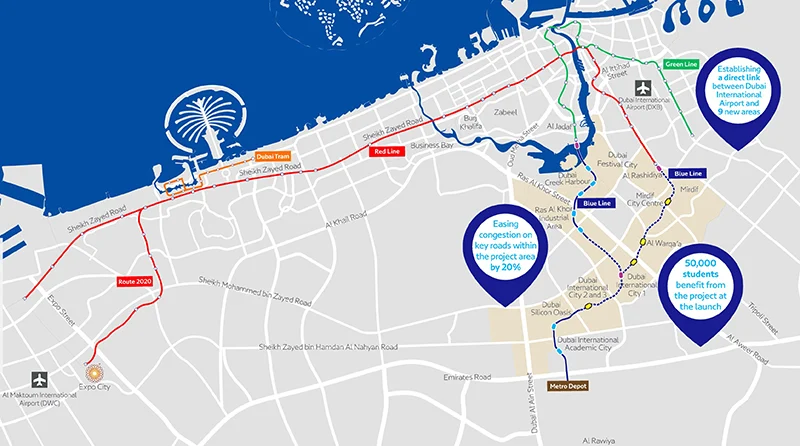
The next major addition is the Dubai Metro Blue Line, which is scheduled to begin operations on September 9, 2029.
The 30-kilometre line will connect the existing Red and Green lines and serve several growing communities, including Mirdif, Al Warqa, International City, Dubai Silicon Oasis and Dubai International Academic City.
RTA says the line will include 14 stations, including three interchange stations. It is also expected to serve areas projected to house around one million residents by 2040.
One of the project’s standout features will be the 74-metre-high Emaar Properties Station, planned in Dubai Creek Harbour. According to Dubai Media Office, it will become the world’s tallest metro station.
The Blue Line will also include a 1.3-kilometre bridge crossing Dubai Creek, adding another distinctive piece of infrastructure to Dubai’s transport network.
What is the Dubai Metro Gold Line?
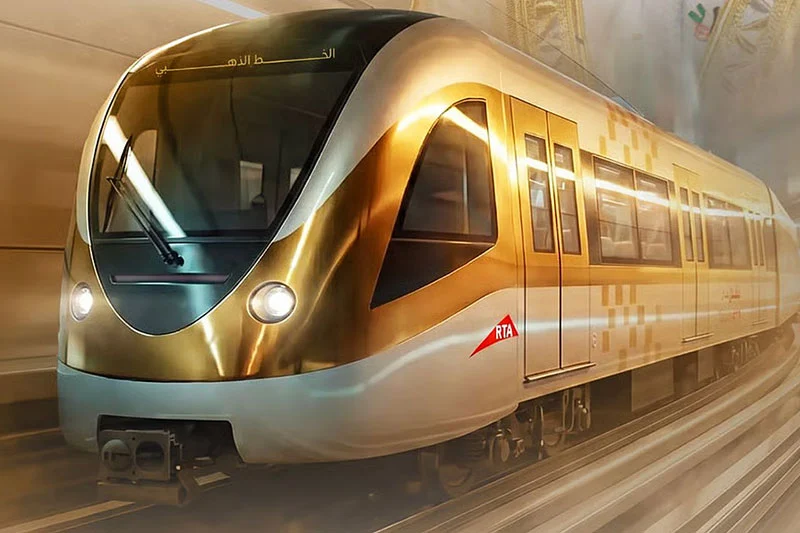
Dubai’s Metro expansion does not stop with the Blue Line.
In April 2026, Dubai approved the AED 34 billion Gold Line, which RTA says will stretch 42 kilometres and include 18 stations.
The line will connect Al Ghubaiba with Jumeirah Golf Estates, with a connection to Etihad Rail planned at the latter.
The Gold Line will be Dubai’s first fully underground Metro line. It is scheduled for completion on September 9, 2032, exactly 23 years after the Metro first opened.
Once the Gold Line is completed, RTA says Dubai’s Metro network will reach 162 kilometres and 85 stations.
Dubai Metro is no longer simply an alternative to driving. For many residents and visitors, it is one of the most practical ways to move around the city.
The growing ridership also reflects Dubai’s changing transport habits. More commuters are using public transport to reach workplaces, residential areas, shopping centres and attractions, while visitors can move between major destinations without relying entirely on taxis or rental cars.
The expansion also matters for businesses. Better Metro connections can improve access to commercial districts, employment hubs and emerging communities, while making areas along new routes more accessible to residents and visitors.
RTA is also working towards a broader target for public transport. The authority says Dubai is aiming for 25 per cent of all trips to be made using public transport by 2030, compared with 22.3 per cent in 2025.
That makes the Metro’s future expansion an important part of Dubai’s wider mobility plans.
FAQs
When did Dubai Metro open?
Dubai Metro officially opened on September 9, 2009, with the Red Line initially operating across 10 stations.
How many passengers has Dubai Metro carried?
Dubai Metro has carried nearly 2.8 billion passengers since its launch, according to RTA.
When will the Dubai Metro Blue Line open?
The Blue Line is scheduled to begin operations on September 9, 2029, marking the Metro’s 20th anniversary.
What is the Dubai Metro Gold Line?
The Gold Line is a planned 42-kilometre Metro line with 18 stations. Approved at a cost of AED 34 billion, it will be Dubai’s first fully underground Metro line and is scheduled for completion in 2032.
What is Dubai’s public transport target for 2030?
Dubai aims to have 25 per cent of trips made using public transport by 2030, according to RTA.
From 10 stations in 2009 to billions of passenger journeys today, Dubai Metro has grown alongside the city it serves. Its next chapter is already taking shape, with the Blue Line and Gold Line set to extend the network into more communities and connect even more parts of Dubai.
As the Metro turns 17, its biggest transformation may still be ahead.
Follow Social Kandura for more updates on local news and things to do in Dubai and across the UAE.
Read More
- dubai metro
- Dubai Metro 17th Anniversary
- Dubai Metro 2009
- Dubai Metro Evolution
- Dubai Metro expansion
- Dubai Metro Facts
- Dubai Metro History
- Dubai Metro Network
- Dubai Metro Since 2009
- Dubai Metro stations
- Dubai Metro Turns 17
- dubai public transport
- Dubai RTA Metro
- dubai transport
- Social Kandura Media
- Social Kandura Media News
- UAE Metro