

The name is familiar. The car is not. The new BMW i3 has nothing in common with the quirky carbon-bodied city hatchback of 2013. It is a full-size premium electric sedan and, in BMW’s own words, the first fully electric BMW 3 Series. It is aimed squarely at the Tesla Model 3, the Mercedes-Benz CLA and the fast-rising Chinese EV brands.
BMW unveiled the i3 on 18 March 2026, and it is the second production car built on the Neue Klasse architecture after the iX3. If the iX3 showed what Neue Klasse could do as an SUV, the i3 shows what it can do in the segment that built BMW’s reputation.
Why the New BMW i3 Matters
The 3 Series is the car every rival measures itself against. It turned 50 in 2025, and for most of that time it has been the benchmark for driver engagement in the compact executive class. An electric 3 Series has to keep that feel while matching the software, efficiency and charging speed of the best EVs. That is a hard brief.
BMW has not replaced the combustion car to do it. The i3 and the petrol 3 Series share the same Neue Klasse design and differ only in details linked to the drive system. Buyers who want an engine still get one, built in Dingolfing. Buyers ready for electric get a purpose-built EV, built in Munich.
The i3 is also central to BMW’s wider plan. The company has talked about launching around 40 new and updated models by the end of 2027, and the 3 Series family is the most important of them.
Design: Neue Klasse in Sedan Form
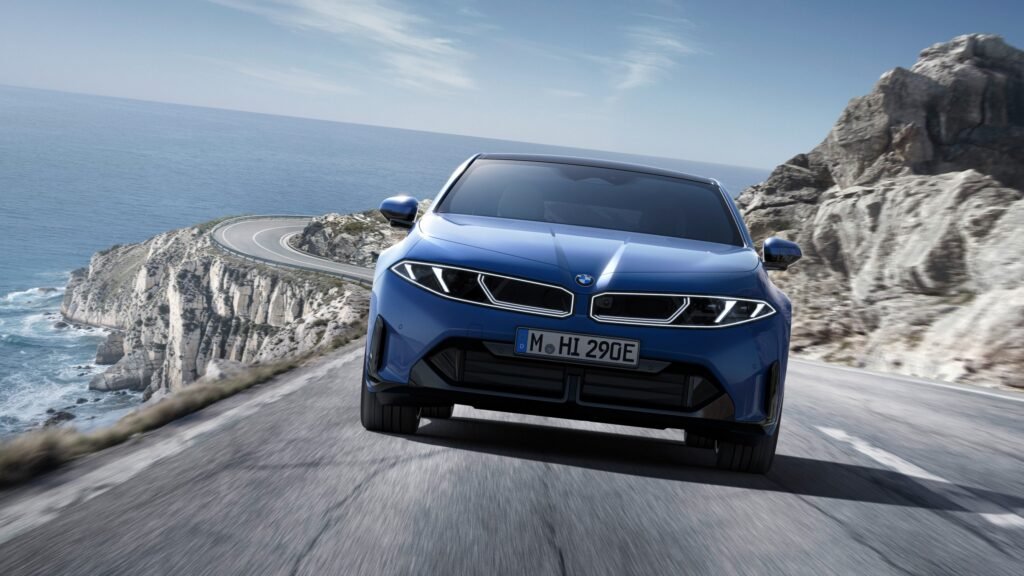
The i3 uses what BMW calls a modern 2.5-box design. The silhouette keeps classic 3 Series proportions: a long wheelbase, short overhangs and a cabin set well back. Flared wheel arches give the shoulders real muscle, while a single character line along the flanks lowers the car’s visual centre of gravity.
The front end reinterprets two BMW icons, the kidney grille and the twin headlights, and merges them into one horizontal light signature. Door handles sit flush and extend when the car is unlocked. At the rear, a wide horizontal light arrangement emphasises the car’s stance.
Wheels range from 19 to 21 inches on the i3. Buyers can add the M Sport package or M Sport package Pro, and launch colours include the exclusive M Le Castellet Blue metallic. More BMW Individual paints follow through 2027.
Performance, Battery and Range
Two dual-motor versions are available from launch, each with one motor on the front axle and one on the rear.
| Model | Output | Torque | 0 to 100 km/h | Battery | WLTP range |
|---|---|---|---|---|---|
| BMW i3 50 xDrive | 345 kW / 469 hp | 645 Nm | 4.7 s | 108.7 kWh | up to 912 km |
| BMW i3 40 xDrive | 275 kW / 374 hp | not stated | not stated | 82.8 kWh | up to 710 km |
The headline figure is range. The i3 50 xDrive covers up to 912 km on the WLTP cycle, which puts it among the longest-range sedans on sale. Real-world range will be lower, especially in Gulf summers when the air conditioning works hard, but the margin is large.
Charging is just as strong. The Gen6 BMW eDrive system uses cylindrical battery cells and 800-volt technology, so the i3 50 xDrive charges at up to 400 kW DC. BMW says ten minutes at a fast charger adds up to 423 km of range. The car also supports bidirectional charging.
A faster model is on the way. BMW has confirmed an i3 M60 xDrive M Performance version for 2027.
Heart of Joy: How the i3 Drives
BMW knows an electric 3 Series has to feel like a 3 Series. Its answer is a high-performance computer called Heart of Joy, which BMW says works ten times faster than previous systems. It brings drive and driving dynamics functions together in a single control unit for the first time, so traction, stability and power delivery react faster and more smoothly.
Adaptive M suspension is available as an option on the i3, and BMW promises sharp, composed handling in the classic 3 Series tradition. Whether it matches the best combustion 3 Series on a mountain road is the question every enthusiast will want answered.
Interior and Technology
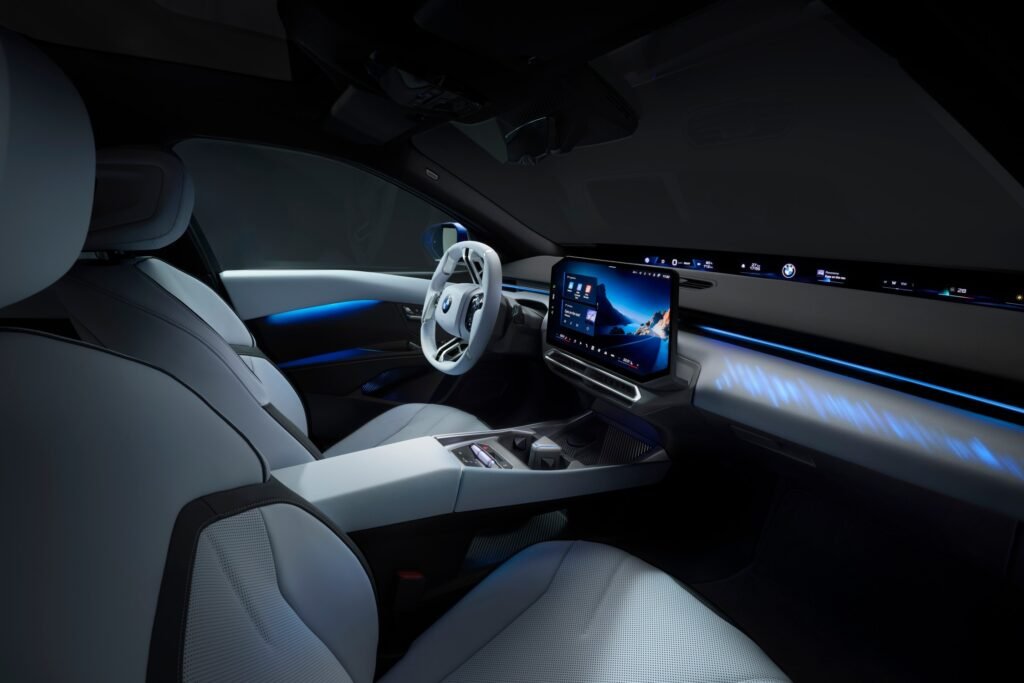
Inside, the i3 uses BMW Panoramic iDrive. BMW Panoramic Vision projects key information along the base of the windscreen, an optional 3D Head-Up Display adds more, and a 17.9-inch Central Display angles towards the driver. A new steering wheel with a central upper spoke carries the main controls.
The software runs on BMW Operating System X, built on the Android Open Source Project and designed for regular over-the-air updates. The BMW Intelligent Personal Assistant gains Amazon Alexa+ AI technology for more natural voice commands. A large panoramic sunroof with climate comfort glazing comes as standard, which matters in the UAE heat.
Driver assistance is a big step forward. The Motorway Assistant allows hands-free driving up to 130 km/h in 21 countries by the end of 2026, and BMW plans navigation-guided city assistance from 2027. Availability in the UAE has not been confirmed.
Production and Launch Timing
The i3 is built at BMW Group Plant Munich, where the first 3 Series rolled off the line in 1975. Production started in August 2026, and the plant will switch fully to electric Neue Klasse models in 2027. UAE pricing and arrival dates have not yet been announced.
Rivals
The Tesla Model 3 is the obvious target. The i3 counters with a more premium cabin, much longer range on paper and the 3 Series badge. The Mercedes-Benz CLA with EQ technology, the Polestar 2, the BYD Seal and Audi’s A6 e-tron, from a class above, complete the picture.
FAQ
When was the new BMW i3 revealed? BMW unveiled the new i3 on 18 March 2026, and production started in Munich in August 2026.
What is the range of the BMW i3 50 xDrive? Up to 912 km on the WLTP cycle, using a 108.7 kWh battery.
How fast does the new BMW i3 charge? The i3 50 xDrive charges at up to 400 kW DC and can add up to 423 km of range in ten minutes.
Is there an M version of the new i3? Yes. BMW has confirmed an i3 M60 xDrive M Performance model for 2027.