
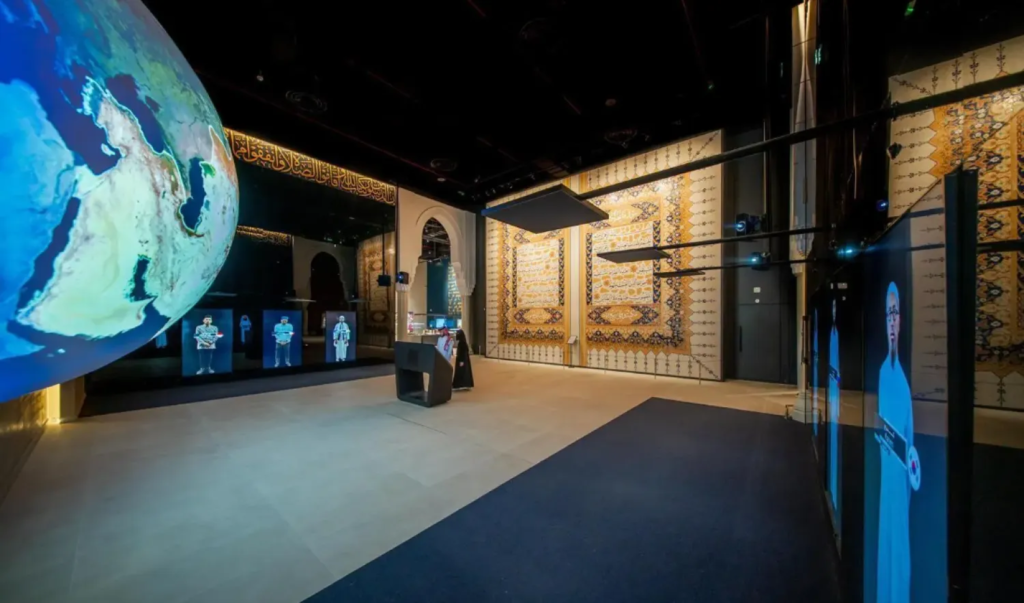
Makkah has quietly unveiled something extraordinary. At the Holy Qur’an Museum inside the Hira Cultural District, visitors can now view the world’s largest handwritten Quran, a manuscript so vast that it stops people mid-step the moment they enter the gallery.
Recently recognised by Guinness World Records, the monumental Quran is not just a display piece. It is a reminder of how deeply faith, patience, and craftsmanship are woven into Islamic history.
For many visitors, including those travelling from the UAE, the experience feels personal. The scale is impressive, yes. But the story behind it is what truly stays with you.
A Quran that immediately draws the eye
The manuscript measures 312 centimetres by 220 centimetres and spans 700 handwritten pages. Seeing it up close puts its size into perspective. Each page feels like a wall of devotion, carefully written and preserved.
Guinness World Records officially confirmed the title, placing the Holy Qur’an Museum on the global cultural stage. The recognition also highlights Saudi Arabia’s growing focus on heritage spaces that educate as much as they inspire.
Much like Dubai’s own cultural districts and museums, the aim here is clear. Preserve history, but present it in a way that speaks to today’s audience.
Inspired by a Quran from the 16th century
What makes this Quran even more meaningful is its origin. The massive manuscript is a scaled-up reproduction of a historic Quran from the 16th century, a time when calligraphy was treated as both worship and scholarship.
The original version was modest in size, measuring 45 centimetres by 30 centimetres. Yet, its influence has lasted centuries. By enlarging the manuscript, curators have allowed visitors to see details that would otherwise remain hidden to the naked eye.
Every letter, pause, and alignment reflects discipline. This was never rushed work. It was written with intention, something that still resonates today.
Calligraphy that tells its own story
The Quran is primarily written in Thuluth script, known for its flowing curves and dignified form. Traditionally used for major religious works, Thuluth adds a sense of grandeur that suits the manuscript’s scale.
Surah Al-Fatiha stands apart, written in Naskh script. Clearer and softer on the eye, Naskh is widely used for reading and recitation. The choice feels deliberate and thoughtful, especially for a chapter recited daily by millions.
The opening pages are richly decorated. Gold accents frame the text, while sun-shaped motifs and symmetrical patterns draw the eye without overwhelming it. The design reflects a time when beauty was considered part of devotion, not an extra.
A manuscript meant for future generations
The original Quran that inspired this reproduction was dedicated as a waqf in 1883, gifted for the benefit of future generations. Today, it is preserved at the King Abdulaziz Complex for Endowment Libraries, cared for under strict conservation standards.
By placing the reproduced version on public display, the Holy Qur’an Museum has struck a balance between protection and access. Visitors can engage with the manuscript without risking damage to the original.
This approach mirrors what many museums in the UAE are now doing, making heritage more accessible while maintaining respect and authenticity.
A shared heritage across the Islamic world
For UAE residents, especially those used to Dubai’s blend of tradition and modern presentation, the experience feels familiar yet deeply moving.
The display speaks to shared values across the region. Respect for knowledge. Patience in craft. Faith expressed through skill, not spectacle.
In an age dominated by screens and speed, the handwritten Quran stands as a quiet contrast. It reminds visitors that some things take time, and that time itself can be an act of devotion.
Hira Cultural District’s growing cultural role
The Hira Cultural District continues to position itself as more than a historical site. With additions like this Quran, it is becoming a destination for learning, reflection, and cultural exchange.
Families, students, and cultural travellers now have another reason to visit. The experience goes beyond viewing an object. It invites people to slow down, observe, and reflect.
Much like cultural landmarks across Dubai and Abu Dhabi, the district is shaping a narrative where heritage is not frozen in the past, but actively shared.
The unveiling of the world’s largest handwritten Quran in Makkah is more than a record-breaking moment. It is a tribute to centuries of Islamic artistry and dedication.
For visitors from the UAE and beyond, it offers a powerful reminder of how faith, culture, and craftsmanship continue to shape the region’s identity.
Follow Social Kandura for more updates on local news, travel stories, things to do, food and lifestyle, and everything shaping life across the UAE.
Read More