

What happened? Sheikh Hamdan bin Mohammed bin Rashid Al Maktoum has marked 20 years as Chairman of Dubai’s Executive Council, with new figures highlighting the emirate’s economic and social growth during the period.
Who is affected? The developments span Dubai’s residents, businesses, investors, visitors and government services.
Why does it matter? Dubai’s GDP reached AED937 billion ($255.1 billion) in 2025, while non-oil foreign trade exceeded AED3 trillion, underlining the emirate’s expanding role as a global business and investment hub.
- Location: Dubai, UAE
- Organisation: Dubai Executive Council
- Status: 20 years of Sheikh Hamdan’s chairmanship
- Who is affected: Residents, businesses, investors and visitors
- Business impact: GDP reached AED937 billion in 2025
- What’s next: Continued investment in infrastructure, digital government and economic development
Hamdan bin Mohammed marks 20 years leading The Executive Council of Dubai @TECofDubai pic.twitter.com/sgIUiyIz6y
— Dubai Media Office (@DXBMediaOffice) September 7, 2026
Dubai’s economy has doubled to AED937 billion ($255.1 billion) as Sheikh Hamdan bin Mohammed bin Rashid Al Maktoum marks two decades as Chairman of the Dubai Executive Council. The figures, released by the Dubai Media Office, highlight how Dubai has expanded across trade, real estate, infrastructure, tourism and government services since Sheikh Hamdan took the role in September 2006.
The milestone comes as Dubai continues to push ahead with new investments and digital government initiatives aimed at supporting its next stage of growth.
Dubai’s GDP doubles over two decades
According to the Dubai Media Office, Dubai’s GDP reached AED937 billion in 2025, effectively doubling over the 20-year period.
The emirate’s economy also grew 5.4% in 2025, according to official Dubai data. GDP growth continued into 2026, with the economy recording AED232 billion in the first quarter and expanding 2.4% year on year.
The figures show that Dubai’s economic growth is not limited to one sector. Construction, healthcare, trade, tourism, finance and other service industries continue to contribute to the economy.
Non-oil foreign trade has also crossed AED3 trillion ($816.8 billion) over the period, reflecting Dubai’s role as a major international trading and logistics centre.
The emirate’s connectivity has played an important role in that expansion, supported by its airports, ports, roads and business infrastructure.
Property remains a major part of Dubai’s growth
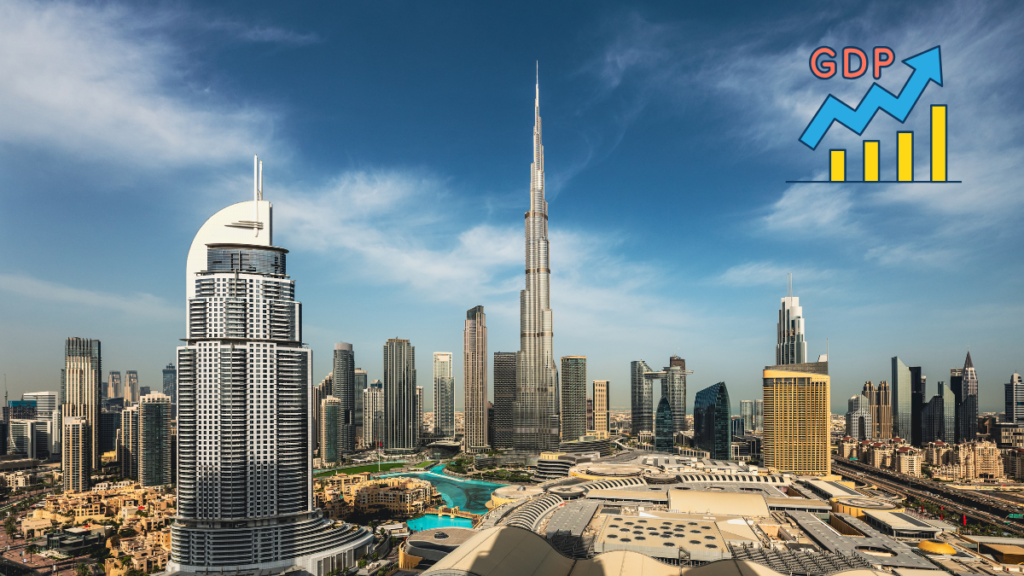
Dubai’s property market has expanded significantly alongside the wider economy.
Real estate transactions reached AED917 billion in 2025, according to the figures released for Sheikh Hamdan’s 20-year milestone.
The scale of activity reflects continued demand from investors, businesses and residents, while new communities and infrastructure have helped support population growth.
Government spending has also been significant. Aggregate government expenditure across key sectors reached AED1.2 trillion during the 20-year period.
That spending has supported infrastructure, public services, housing and development projects across the emirate.
For Emirati families, the government says integrated housing solutions worth AED50 billion have been delivered during the same period.
Roads, green spaces and communities have expanded
Dubai’s physical transformation is also reflected in its infrastructure figures.
The emirate now has 25,974 lane-kilometres of roads, connecting residential areas with business districts, services and transport networks.
Green spaces have expanded to more than 55.7 million square metres, adding to Dubai’s public areas and community facilities.
The emirate has also established 27 majlis and community centres, supporting social interaction and providing spaces for residents to engage with their communities.
Tourism has grown alongside these developments. Dubai has welcomed 20 million visitors, strengthening sectors including hotels, restaurants, transport, retail and entertainment.
Quality of life remains a key focus
The 20-year review also highlighted social and quality-of-life indicators.
According to the Dubai Media Office, 99.9% of individuals surveyed said they feel safe in Dubai. Healthy life expectancy has reached 80.75 years, while customer happiness across Dubai Government stands at 95%.
Government employee happiness was recorded at 89.3%.
Education is another area where Dubai continues to build its international standing, with the emirate ranking among the world’s top five in several international education assessments.
These indicators matter because Dubai’s growth strategy extends beyond attracting companies and investment. The emirate has increasingly focused on making its services, communities and infrastructure work for its growing population.
Dubai prepares for its next growth phase
The 20-year milestone comes as Dubai continues to invest in its future.
The emirate’s 2026–2028 budget cycle totals AED302.7 billion in expenditure, with projected revenues of AED329.2 billion. The three-year budget is the largest in Dubai’s history and is designed to support infrastructure, economic development and public services.
In March 2026, Sheikh Hamdan also approved AED1 billion in economic incentives, alongside measures supporting areas such as tourism, customs, residency and business activity.
In July, he approved another AED18 billion in new projects and strategies covering infrastructure, trade, culture, investment, finance, Emiratisation, urban planning and population data.
Digital government is another priority. Sheikh Hamdan directed Dubai Government entities to integrate individual and business services into a unified digital platform within one year, supporting the emirate’s wider shift towards data-driven and AI-enabled government services.
Its importance
For Dubai residents, the figures represent more than economic growth. The investment behind them affects roads, housing, public services, green spaces, healthcare, tourism and everyday government transactions.
Businesses and investors benefit from Dubai’s expanding trade links, infrastructure and economic support measures, while visitors continue to benefit from the emirate’s growing tourism and hospitality ecosystem.
The next phase is likely to focus heavily on digital government, infrastructure, investment and economic diversification as Dubai works towards its longer-term development targets.
FAQs
How long has Sheikh Hamdan led Dubai’s Executive Council?
Sheikh Hamdan bin Mohammed bin Rashid Al Maktoum has served as Chairman of Dubai’s Executive Council since September 2006, marking 20 years in the position in 2026.
What is Dubai’s GDP in 2025?
Dubai’s GDP reached AED937 billion ($255.1 billion) in 2025, according to official Dubai government figures.
How much has Dubai’s non-oil foreign trade grown?
Dubai’s non-oil foreign trade exceeded AED3 trillion ($816.8 billion) over the 20-year period covered by the review.
How much did Dubai spend on government development?
Aggregate government expenditure across key sectors reached AED1.2 trillion over the past two decades.
What is next for Dubai’s economy?
Dubai is continuing to invest in infrastructure, digital government, business support, tourism and economic diversification. Its 2026–2028 budget cycle provides AED302.7 billion in planned expenditure.
Sheikh Hamdan’s 20 years at the Dubai Executive Council come against a period of major economic and urban transformation. With GDP reaching AED937 billion, trade exceeding AED3 trillion and continued investment planned across infrastructure and government services, Dubai is now entering its next phase with growth and digital transformation firmly on the agenda.
Follow Social Kandura for more updates on local news and things to do in Dubai and across the UAE.
Read More