

What happened?
The UAE has unveiled the latest advancements in its cloud seeding programme, including AI-powered weather analysis, advanced seeding materials and next-generation rainfall enhancement research.
Who is affected?
UAE residents, industries that depend on water resources, agriculture, environmental researchers and the country’s water management sector.
Why does it matter?
The new technologies aim to improve rainfall enhancement efficiency, support the UAE’s long-term water security strategy and reduce dependence on limited freshwater resources.
The UAE is taking another major step towards improving rainfall by combining artificial intelligence with advanced cloud-seeding technology. The National Center of Meteorology (NCM), through the UAE Research Programme for Rain Enhancement Science (UAEREP), is investing in smarter forecasting tools, innovative seeding materials and next-generation weather research to make rain enhancement more precise. As one of the driest countries in the world, the UAE sees these developments as an important part of its long-term strategy to strengthen water security and support sustainable development.
How do scientists improve the effectiveness of rain enhancement?
— UAEREP (@UAEREP) July 21, 2026
Understanding the movement of seeding materials within clouds helps researchers refine rain enhancement techniques and deepen our understanding of rainfall formation pic.twitter.com/GpgZlryBJR
How does cloud seeding work in the UAE?
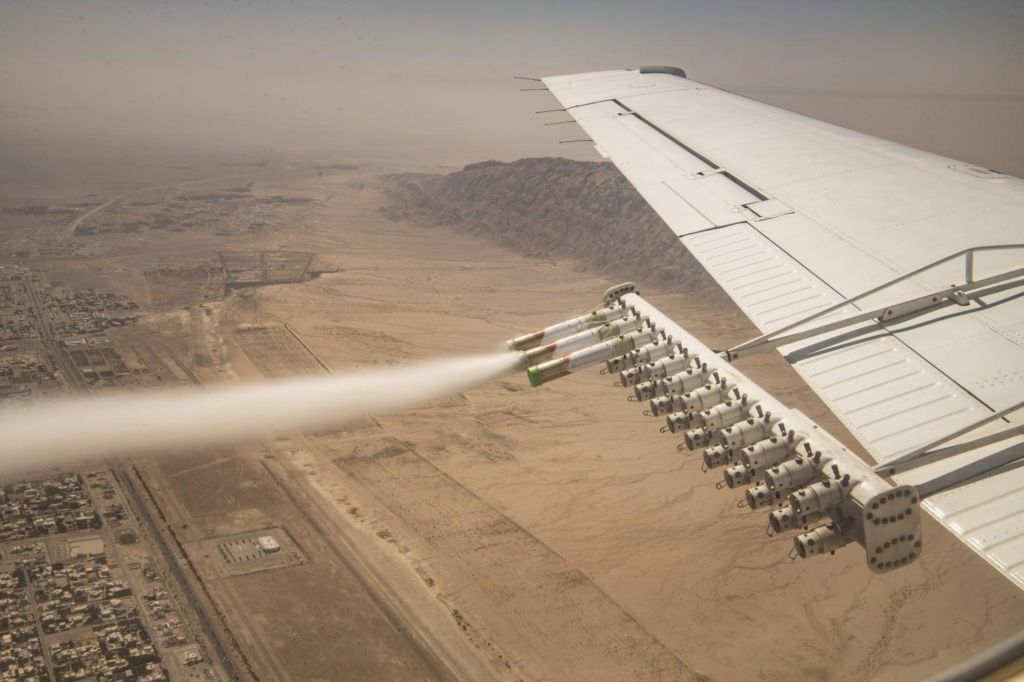
Cloud seeding has been part of the UAE’s weather modification programme for more than two decades. Contrary to popular belief, the process does not create clouds or guarantee rainfall. Instead, it helps naturally occurring rain-bearing clouds produce more precipitation.
Specially equipped aircraft release tiny salt-based particles into suitable clouds. These particles attract moisture, allowing small water droplets to combine into larger ones that eventually become heavy enough to fall as rain.
The success of every mission depends on several factors, including cloud type, humidity, wind conditions and the timing of releasing the seeding material. That is why the UAE continues to invest heavily in research and technology to improve precision.
AI is making cloud seeding more accurate
Artificial intelligence is becoming one of the biggest game changers in the UAE’s rain enhancement programme.
According to UAEREP, AI models are being developed to analyse cloud behaviour, weather patterns and atmospheric conditions in real time. This allows meteorologists to identify the best clouds to seed and determine the ideal timing for each operation.
Instead of relying solely on conventional forecasting methods, researchers can now process massive amounts of weather data within minutes. This improves operational efficiency while reducing unnecessary cloud-seeding missions.
The programme is also building sophisticated numerical models capable of simulating the chemical, electrical and physical processes that occur inside clouds, giving scientists a much clearer picture of rainfall formation.
New cloud-seeding materials are improving results
Traditional cloud seeding in the UAE uses hygroscopic flares containing natural salts such as sodium chloride and potassium chloride.
These flares are fired from aircraft into cloud updrafts, where they help water droplets grow.
However, UAEREP-supported researchers have developed advanced nanomaterials that offer a significant improvement over conventional flares.
These engineered particles disperse much faster inside clouds and provide a larger surface area for moisture to collect. Researchers say the technology has the potential to improve rainfall efficiency while lowering operational costs.
Another milestone is the establishment of the Emirates Weather Enhancement Factory, the first facility in the Middle East and North Africa dedicated to manufacturing environmentally friendly cloud-seeding materials locally.
Producing the materials within the UAE also reduces supply costs and supports local scientific innovation.
The UAE continues investing in future rain enhancement research
The country’s rain enhancement programme goes far beyond traditional cloud seeding.
UAEREP recently announced three new international research projects under its latest grant cycle, with each project receiving funding of up to US$1.5 million over three years.
The selected projects focus on:
- AI-assisted cloud-seeding materials
- Advanced radar systems powered by artificial intelligence
- Land-cover modification techniques to improve rainfall formation
Researchers are also studying cloud electrification, where electrical charges are introduced into suitable clouds to encourage precipitation.
Although these technologies are still being researched, they demonstrate the UAE’s long-term commitment to becoming a global leader in weather enhancement science.
UAEREP has also confirmed that its upcoming research roadmap towards 2030 will prioritise artificial intelligence, autonomous systems, climate intervention technologies and next-generation cloud modelling.
Why water security remains a national priority?
The UAE receives less than 100mm of rainfall each year and depends heavily on desalinated seawater to meet growing demand.
Rain enhancement forms one part of the country’s wider water security strategy alongside desalination, groundwater management and water conservation initiatives.
Officials have repeatedly clarified that cloud seeding cannot produce rain from clear skies or create storms. Instead, it enhances rainfall only when naturally suitable clouds are already present.
By improving the efficiency of each mission, the UAE hopes to maximise every rainfall opportunity while continuing to invest in sustainable water management.
Why It Matters?
The latest advancements could have long-term benefits across several sectors.
For UAE residents
- Supports long-term water sustainability.
- Improves scientific forecasting capabilities.
For businesses
- Helps strengthen water resilience for future economic growth.
- Supports industries that depend on reliable water resources.
For researchers
- Positions the UAE as a global hub for weather modification research.
- Encourages international collaboration in climate science.
What’s next?
The UAE will continue testing AI-powered forecasting, advanced cloud simulations and next-generation seeding technologies under its future research programmes.
FAQs
Does cloud seeding create rain from clear skies?
No. Cloud seeding only works when naturally occurring clouds with enough moisture are already present.
Who manages cloud seeding in the UAE?
The programme is managed by the National Center of Meteorology (NCM) through the UAE Research Programme for Rain Enhancement Science (UAEREP).
Why is AI being used in cloud seeding?
AI helps scientists analyse cloud conditions in real time and identify the best opportunities for successful cloud-seeding missions.
Why is cloud seeding important for the UAE?
The technology supports the country’s long-term water security strategy by helping increase rainfall from suitable natural clouds.
Can cloud seeding replace desalination?
No. It complements other water security measures such as desalination, groundwater management and water conservation.
The UAE continues to strengthen its position as one of the world’s leading investors in rain enhancement science. By combining artificial intelligence, advanced cloud-seeding materials and cutting-edge weather research, the country aims to improve rainfall efficiency while supporting long-term water security. Although cloud seeding is only effective under suitable weather conditions, continued investment in research and innovation is helping shape the future of weather modification in the region.
Follow Social Kandura for more updates on local news and things to do in Dubai and across the UAE.
Read More