

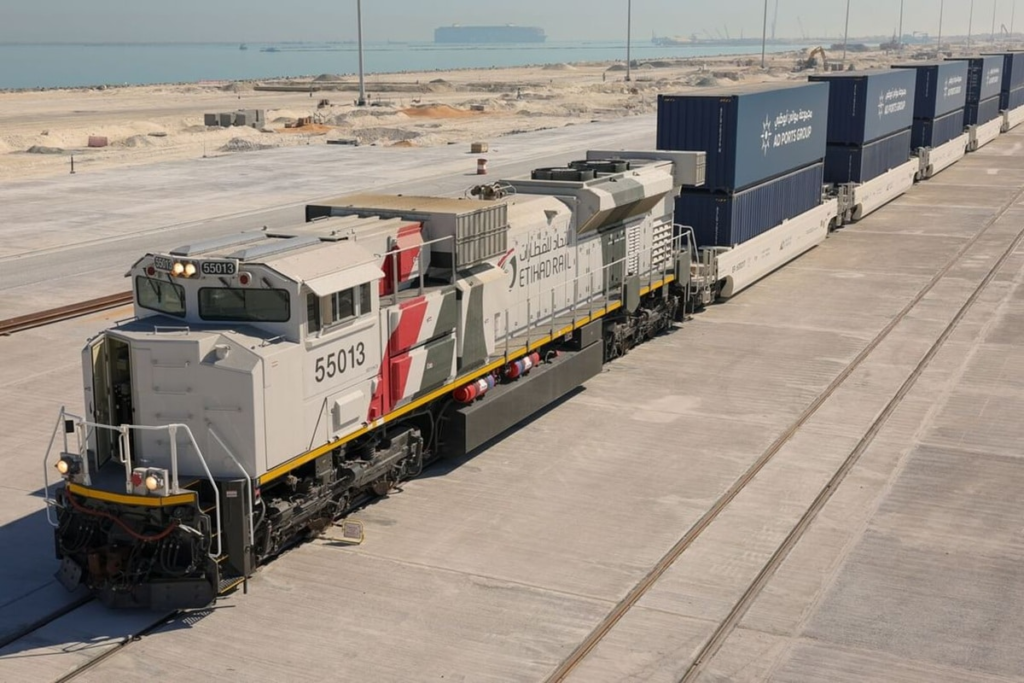
Etihad Rail and AD Ports Group have launched a new direct rail freight service between Fujairah Terminals and the Industrial City of Abu Dhabi (ICAD). The approximately 200km route will operate three times a week and allow cargo arriving at Fujairah to move directly by rail to ICAD for customs clearance, inspection and release.
The service is aimed at importers, exporters, manufacturers, distributors and logistics companies. It is expected to simplify cargo handling and bring goods closer to warehouses, factories and other end markets in Abu Dhabi.
- Route: Fujairah Terminals to ICAD, Abu Dhabi
- Organisations: Etihad Rail and AD Ports Group
- Status: Launched on September 20, 2026
- Who is affected: Importers, exporters, manufacturers and logistics providers
- Business impact: Direct rail movement with customs, inspection and cargo release at ICAD
- What’s next: Further integration of UAE ports, industrial areas and logistics hubs
Etihad Rail and AD Ports Group have launched a new Fujairah to Abu Dhabi freight route, connecting Fujairah Terminals directly with the Industrial City of Abu Dhabi (ICAD). The approximately 200km rail service will run three times a week and allow cargo arriving on the UAE’s East Coast to continue by rail to ICAD for customs clearance, inspection and release.
The new service creates another link between the UAE’s port infrastructure and its industrial centres, giving businesses an alternative to moving cargo entirely by road.
How will the new Fujairah-Abu Dhabi rail service work?
Under the new arrangement, cargo arriving at Fujairah Terminals can be booked directly to ICAD and transported approximately 200km by rail.
Once the goods reach ICAD, customers can access customs clearance, inspection and cargo release services at the inland gateway. This means businesses do not need to treat the port and final customs location as completely separate stages of the shipment process.
The service is designed to reduce additional cargo handling and bring imported goods closer to businesses operating in Abu Dhabi’s industrial areas.
According to AD Ports Group, the route is particularly relevant to companies that need to move cargo towards warehouses, production facilities and end markets across Abu Dhabi.
What is ICAD’s new AECAD code?
One of the key developments behind the new service is the designation of ICAD with its own UN/LOCODE, AECAD.
A UN/LOCODE is used to identify locations involved in international trade and transport. With AECAD, shipping lines, freight forwarders and cargo owners can book ICAD directly as the cargo destination and clearance point.
This gives ICAD a more direct role in the international logistics chain.
Etihad Rail had already connected the ICAD railway freight terminal to the UAE National Rail Network in 2022. At the time, the company described the facility as the country’s largest inland freight railway terminal. The terminal was designed to support industrial cargo distribution and customs services.
Why is Fujairah important for UAE cargo?
Fujairah Terminals provides a maritime gateway on the UAE’s East Coast, giving businesses access to the Gulf of Oman without requiring cargo to first pass through ports located inside the Arabian Gulf.
AD Ports Group said the wider Fujairah Terminals ecosystem supports trade connections with markets across the GCC, India, the Red Sea and East Africa.
The new rail connection therefore links an important eastern maritime gateway with Abu Dhabi’s industrial base.
For businesses importing goods through Fujairah, the new service provides a direct rail option for moving cargo towards ICAD instead of relying solely on road transport for the inland journey.
How does the route fit into the UAE National Rail Network?
The new corridor builds on the wider UAE National Rail Network, which stretches approximately 900km from Ghuwaifat to Fujairah and connects key ports, cities and industrial hubs. Etihad Rail currently operates freight services across 11 terminals and four major ports.
Freight operations have been active since 2023, and Etihad Rail has continued expanding the commercial use of the national network.
The company reported that its freight operations had transported more than 6.5 million tonnes of sulphur, over 10 million tonnes of aggregates and 148,000 containers, highlighting the growing role of rail in the UAE’s logistics system.
The national network was designed to connect major ports and industrial centres while supporting the movement of different types of cargo, including raw materials, manufactured goods and containers.
What does the new service mean for UAE businesses?
The biggest change is the ability to combine port access, rail transport and inland customs services within one logistics flow.
For importers and manufacturers, this can mean fewer cargo-handling stages and a more direct route towards industrial facilities in Abu Dhabi.
Etihad Rail said the Fujairah-ICAD service is intended to provide reliable schedules and additional capacity for high-volume cargo. The companies also said rail can help reduce road congestion and emissions compared with traditional long-distance trucking.
The development is also relevant to Abu Dhabi’s industrial and logistics ambitions. ICAD is home to a large concentration of manufacturing and industrial activity, making direct access to ports and freight infrastructure particularly important for companies handling regular cargo volumes.
The new Fujairah-ICAD connection is mainly a business and logistics development, but its impact extends across the wider UAE supply chain.
Importers can use Fujairah as an East Coast maritime gateway before moving cargo directly towards Abu Dhabi by rail. Manufacturers and distributors can receive goods closer to their operational bases, while freight forwarders gain another option for moving cargo across the country.
For the UAE, the service adds another practical connection between ports, industrial zones and the national rail network.
As Etihad Rail continues developing freight and passenger services, the expansion of these connections is expected to play a role in how goods and people move between the emirates.
FAQs
How long is the new Etihad Rail Fujairah-Abu Dhabi route?
The new Fujairah-ICAD freight route covers approximately 200km between Fujairah Terminals and the Industrial City of Abu Dhabi.
How often will the Fujairah-ICAD freight service operate?
The direct freight service will operate three times a week, according to Etihad Rail and AD Ports Group.
Can cargo be cleared through customs at ICAD?
Yes. Cargo arriving at Fujairah Terminals can be transported by rail to ICAD, where customers can access customs clearance, inspection and cargo release services.
What is the UN/LOCODE for ICAD?
ICAD has been designated with the UN/LOCODE AECAD, allowing shipping lines, freight forwarders and cargo owners to book ICAD directly as a destination and clearance point.
Who can use the new Fujairah-ICAD service?
The service is aimed at importers, exporters, manufacturers, distributors and logistics providers operating across Abu Dhabi and the wider UAE.
The new Fujairah-ICAD rail service gives UAE businesses another direct way to move cargo from the East Coast to Abu Dhabi’s industrial heartland. By combining Fujairah Terminals, Etihad Rail’s national network and customs services at ICAD, the new route strengthens the connection between the UAE’s ports and industrial centres.
Follow Social Kandura for more updates on local news and things to do in Dubai and across the UAE.
Read More