

The UAE has successfully launched LEONAV-1, its first satellite dedicated to satellite navigation research. Developed by the National Space Science and Technology Center at the Emirates University and backed by the UAE Space Agency, the satellite tests next-generation positioning technologies from low Earth orbit. The project reflects broader national ambitions to reduce dependence on traditional GPS systems and position the UAE as a leader in emerging space technologies.
On July 7, the National Space Science and Technology Center (NSSTC) at the United Arab Emirates University achieved a major milestone when LEONAV-1 launched aboard SpaceX’s Transporter-17 rideshare mission. It represents far more than a single satellite—it signals the beginning of an ambitious national effort to develop the UAE’s own positioning, navigation, and timing system based on satellites in low Earth orbit.
The successful deployment marks a turning point in how the UAE approaches its space strategy. Rather than relying solely on existing global systems like GPS, Galileo, or BeiDou, the nation is investing in homegrown capabilities that could eventually deliver more accurate, resilient, and locally controlled navigation services. It is a bold move that positions the UAE alongside established space powers pioneering next-generation navigation infrastructure.
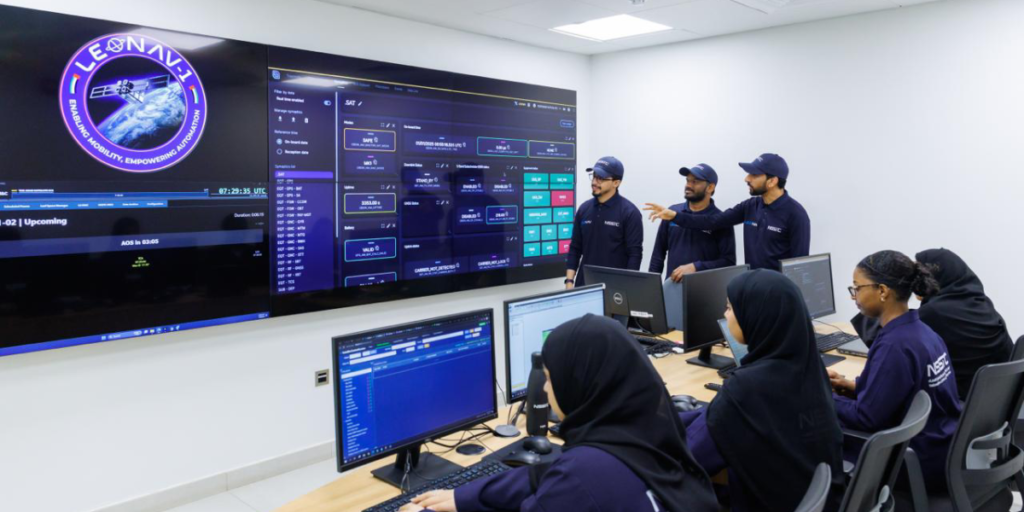
Testing Tomorrow’s Navigation Technology
LEONAV-1 is designed as what engineers call a technology demonstrator—a CubeSat platform for validating concepts before building a full constellation. The mission aims to transmit GNSS-like signals within the L5/E5 and S frequency bands without causing interference to existing navigation systems. This careful approach is critical. The satellite must prove it can operate alongside established systems without disruption while demonstrating genuine technical advantages.
The satellite will assess the performance of onboard software that determines its orbit and maintains precise time synchronisation—capabilities essential for any functioning navigation system. Because LEO satellites operate much closer to Earth than traditional navigation satellites, they can provide stronger signal performance, potentially overcoming some weaknesses of systems positioned thousands of kilometres higher in orbit.
These technical objectives translate into real-world benefits. Stronger signals mean better performance in urban canyons, forests, and other challenging environments where traditional GPS struggles. They also mean potential resilience gains—a system using LEO satellites could provide backup or augmentation if higher-orbit systems face disruption.
Part of a Bigger Vision
LEONAV-1 is not the endpoint but the beginning. The project is part of what the UAE calls the Global Navigation Satellite Systems Augmentation System (GNSSaS) programme. This programme aims to develop a Low Earth Orbit constellation of CubeSats or small satellites to provide GNSS navigation, promising improved performance and resilience at lower cost relative to other GNSS and GNSS augmentation systems.
The strategic logic is straightforward. The global space economy, valued at around $613 billion in 2024 and projected to reach nearly $780 billion by 2033, is expanding rapidly. Nations and companies competing in this space increasingly view satellite navigation as critical infrastructure. For the UAE, developing this capability locally offers both technological independence and potential commercial opportunity.
This vision aligns with broader national priorities. In May, Sheikh Hamdan bin Mohammed, Crown Prince of Dubai, Deputy Prime Minister and Minister of Defence, unveiled a Dh1 billion International Space Co-operation Programme to advance the UAE’s role in the global space sector. That initiative explicitly targets space research and development, technology localisation, and the development of Emirati talent—precisely what LEONAV-1 represents in practical form.
Building National Capacity
Beyond the technical mission, LEONAV-1 serves an equally important purpose: developing Emirati expertise. The NSSTC operates the UAE’s only comprehensive Assembly, Integration, and Testing (AIT) facility, enabling the country to build, test, and qualify space systems in-house. This infrastructure represents years of accumulated capability. LEONAV-1 benefits from that foundation and, in turn, expands it.
Each engineer, technician, and researcher involved in the mission gains hands-on experience with satellite systems that few institutions in the region can offer. When the UAE eventually builds a full constellation—if the demonstrator succeeds—that expertise will prove invaluable. The project becomes a training ground for the next generation of Emirati space professionals.
This human dimension matters enormously. Space agencies globally recognise that developing competitive space sectors requires sustained investment in talent. The UAE is making that investment deliberately, starting with foundational projects like LEONAV-1.
A Moment for the Region
The launch also carries symbolic weight for the broader Gulf region. While established space powers focus on deep space exploration or massive Earth observation constellations, the UAE is tackling a different challenge: proving that emerging space nations can develop critical infrastructure that rivals systems built by superpower space agencies.
Success would demonstrate that sophisticated space technology is not exclusively the domain of the United States, Europe, Russia, or China. It would show that a focused, well-funded effort by a smaller nation, backed by world-class universities and strategic partnerships, can produce genuinely competitive systems.
For Dubai and the UAE, the timing aligns with broader economic diversification. The emirate’s economy has long relied on trade, finance, and tourism. Space technology and satellite services represent emerging sectors where the UAE can build a genuine competitive advantage—not just participate, but lead.
What Comes Next?
LEONAV-1 is currently in its Launch and Early Orbit Phase, undergoing system checks and establishing ground communications. Over the coming months, mission controllers will verify that all equipment functions correctly and conduct the tests necessary to achieve the mission’s scientific objectives.
If those tests succeed, expect announcements about the next phase: building and launching additional satellites to form a small operational constellation. Success would validate the concept and justify the investment in a full system.
The global navigation market has room for innovation. Existing systems serve billions of users but have known limitations. A system designed from scratch to operate in low Earth orbit, built with modern technology and satellite architecture, could offer advantages worth pursuing—particularly for applications demanding precision, reliability, or operation in challenging environments.
Why It Matters to You?
For residents and businesses in Dubai and across the UAE, LEONAV-1 represents more than a technical achievement. It signals that the nation’s space ambitions extend beyond spectacular missions to Mars or the Moon. It shows investment in practical, foundational infrastructure—the kind that eventually touches everyday life through improved navigation, timing, and positioning services.
It also reflects confidence in Emirati innovation and engineering capability, a message that resonates far beyond the space sector.
FAQ‘s
Q: What is LEONAV-1?
A: LEONAV-1 is the first Emirati satellite dedicated to satellite navigation research. Developed by the National Space Science and Technology Center at the UAE University and funded by the UAE Space Agency, it tests next-generation positioning technologies from low Earth orbit.
Q: How does LEONAV-1 differ from GPS?
A: GPS satellites operate at a much higher altitude. LEONAV-1 tests a low Earth orbit approach that could provide stronger signals, especially in urban areas and challenging environments where traditional GPS weakens.
Q: Is LEONAV-1 meant to replace GPS?
A: No. LEONAV-1 is a demonstrator for an augmentation system—technology designed to work alongside and improve existing navigation systems like GPS and Galileo, not replace them.
Q: What will happen to LEONAV-1 next?
A: The satellite is currently undergoing system checks and early orbit testing. If successful, it will conduct the planned mission to validate navigation signals and test onboard software performance.
Q: Why is this important for the UAE?
A: The project develops national expertise in satellite systems, reduces dependence on foreign navigation infrastructure, and positions the UAE to compete in the growing global space economy.
LEONAV-1 represents a quieter but no less ambitious dimension of the UAE’s space programme. While Mars missions and Moon rovers capture headlines, foundational infrastructure projects like this navigation satellite build the capabilities that sustain long-term leadership in space.
The next few months will reveal whether the satellite performs as designed. If it does, expect the UAE to move decisively toward building a full constellation. Success would mark another first for the nation—not merely in reaching space, but in building space-based services that benefit users for decades to come.
Follow Social Kandura for more updates on local news and things to do in Dubai and across the UAE.
Read More
- LEONAV-1
- LEONAV-1 mission
- Mohammed Bin Rashid Space Centre
- navigation technology UAE
- satellite navigation system
- Social Kandura Media
- Social Kandura Media News
- space industry UAE
- space-based navigation UAE
- UAE aerospace
- UAE navigation satellite
- UAE satellite mission
- UAE satellite technology
- UAE space innovation
- UAE space navigation
- UAE space program
- UAE space technology