

Dubai is getting ready to take transport to the skies — and Dubai Mall could soon play a central role in that journey.
The city’s flying taxi project is no longer just a futuristic concept. Plans are actively underway to launch Dubai flying taxis in 2026, with Dubai Mall expected to become one of the main vertiport locations in the first operational network.
A vertiport is essentially a mini air terminal. It’s where electric air taxis take off, land, recharge, and board passengers. Think of it as a rooftop station for the sky.
For a city that already moves fast, this is another big step forward.
Why the Dubai Mall fits the plan?
Dubai Mall isn’t just a shopping destination. It’s a transport magnet.
It connects Downtown Dubai, Business Bay, DIFC, Sheikh Zayed Road, and major tourist zones. Add in daily footfall from residents, office workers, and visitors, and it becomes clear why it’s being positioned as a flying taxi hub.
From a local perspective, it makes sense. Downtown traffic during peak hours is no joke. Anyone who has tried to get from DXB to Dubai Mall on a busy evening knows how unpredictable the roads can be. A vertiport here creates a fast-track connection between major parts of the city — without touching Sheikh Zayed Road.
Joby Aviation recently showcased a full-scale mock-up of its electric aircraft at Dubai Mall, giving residents a first real look at what these air taxis will feel like. Quiet. Clean. Compact. Designed for city travel, not luxury spectacle.
This isn’t about replacing helicopters. It’s about everyday urban movement — faster, calmer, and more efficient.
Inside Dubai’s flying taxis
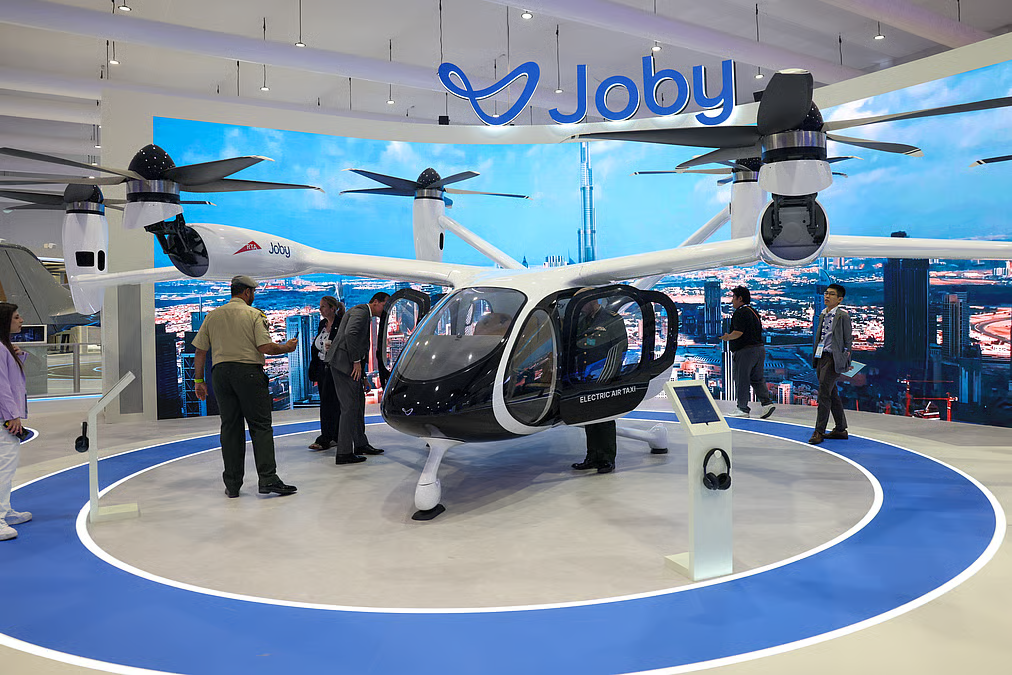
Dubai’s flying taxis are electric vertical take-off and landing aircraft — known as eVTOLs.
Each aircraft will carry:
- One pilot
- Four passengers
They’re fully electric, low-noise, and designed specifically for short city routes. No roaring engines. No helicopter-style turbulence. Just smooth vertical lift and forward flight.
Top cruising speed reaches around 320 km/h, which makes short trips across Dubai incredibly quick. In real terms, that means:
- DXB to Palm Jumeirah: around 10–12 minutes
- Marina to Downtown: minutes instead of traffic delays
- Airport to city hubs: no road congestion at all
This is where the impact becomes real for residents. It’s not just about novelty. It’s about time.
Less time commuting. Less time stuck in traffic. More predictable travel across the city.
The first flying taxi routes in Dubai
The initial flying taxi network is being built around Dubai’s busiest and most strategic locations:
- Dubai International Airport (DXB)
- Palm Jumeirah
- Dubai Marina
- Downtown Dubai / Dubai Mall
These aren’t random choices. They connect tourism zones, business districts, residential communities, and transport gateways.
For residents, that means future travel options that connect home, work, and lifestyle areas in one system. For visitors, it creates a direct connection between the airport and Dubai’s most popular destinations.
Over time, this network is expected to grow. But the first phase is about making the system reliable, safe, and functional before expansion.
How booking and travel will work?
Flying taxis won’t feel like booking a flight. The experience is designed to feel more like booking a premium ride.
Passengers will book trips through apps — similar to ride-hailing services — selecting pickup and drop-off vertiports instead of street locations.
The journey flow will be simple:
- Book your flight
- Arrive at the vertiport
- Quick check-in process
- Board the aircraft
- Fly
- Connect to ground transport at your destination
Each vertiport will operate like a small terminal. Clean waiting areas. Climate-controlled lounges. Fast boarding. Smooth transfers.
The idea is seamless travel — not complicated aviation procedures.
How much a ride might be?
Flying taxis won’t be cheap at first — but they’re not designed to be ultra-luxury either.
Early pricing is expected to sit close to premium taxi services, similar to high-end ride options. Over time, as operations scale and more aircraft enter service, costs are expected to come down.
The long-term goal is accessibility. Not just for tourists or executives, but for regular residents who want faster city travel.
It’s not about replacing taxis or the metro. It’s about adding a new layer to Dubai’s transport system.
What this means for everyday Dubai life?
Dubai has always been a city that adopts technology early. Smart roads. Smart traffic systems. Autonomous transport trials. Electric vehicles. Hyperloop concepts. And now flying taxis.
But what makes this different is that it’s not just experimental anymore. It’s operational planning.
For residents, it could change how long-distance city travel feels. For businesses, it opens new mobility options. For tourism, it adds a new experience layer to the city.
And for Dubai’s global image, it reinforces something the city has always been known for — not just building big, but building first.
Flying taxis won’t replace the metro. They won’t replace taxis. They won’t replace cars. But they will add something new.
- Another option.
- Another route.
- Another way to move.
And in a city like Dubai, choice is everything.
Dubai’s transport future is officially lifting off — and this is only the beginning.
From flying taxis to smart mobility, the city keeps redefining how people move, live, and travel.
Follow Social Kandura for more updates on things to do, local news, travel, Bollywood, food and lifestyle across Dubai and the UAE.
Read More